Orthodontic treatments are used for patients with crowded teeth, worn down teeth, irregular and misaligned teeth, and deep bite. Orthodontic treatment has become more popular to treat both children and adults. To correct tooth alignment not only optimises tooth bite but also makes brushing and flossing easier, helping you to keep your teeth healthy and improve your smile with straighter teeth.
The main advantage of orthodontics as part of an aesthetic treatment is that it minimises any changes to the existing teeth. It is generally more cost effective for our dental patients and less invasive compared to other dental treatment options.
Many dental patients are surprised to learn that they can improve their smile with dental treatments such as teeth whitening, or bleaching and orthodontics rather than costly teeth veneers. Using veneers to straighten teeth can sometimes result in bulky uncomfortable restorations as well as extensive preparation of otherwise healthy teeth.
For example, if a back tooth is lost and something not placed in the gap, like a dental implant or bridge, all of the teeth next to the gap will begin to move into the gap. The teeth behind and in front will typically tilt in the direction of the gap, and even the tooth opposite in the opposite jaw will ‘overerupt’ as there is no longer chewing pressure keeping it in place.
Of course this will happen at different rates for different people, but ultimately it affects everyone. We do recommend implants for missing teeth as they do not require disturbing healthy adjacent teeth as is the case with making a bridge. There are a variety of methods of preparing bridges, most all of which do require cutting into the adjacent teeth to anchor the bridge.
Modern orthodontic treatment usually involves the use of fixed braces to move teeth, enabling patients to be treated to a high standard and giving the best possible dental results.
Treatment options are more varied now than ever. Conditions that were not possible to be treated can now be treated as a matter of course and there are now treatment options that provide fast more simplified treatment for straightening front teeth – especially useful in adults not wanting to go through longer full orthodontic treatments.
The reason that braces work so well in Orthodontic treatment, now more so in adults. Is that teeth will readily move to a new position with braces but also if there is no resistance in a particular direction when teeth are missing or lost.
It is important to seek dental advice. If tooth misalignment is not treated this can often be the beginning of the collapse of an otherwise healthy mouth, a domino effect if you like.
Lingual braces are placed on the inside (backs) of the teeth in a similar fashion to labial braces (most common fixed braces) and are an equally effective option. Although these are more expensive in that they require specialist expertise and longer visits they have the huge advantage of being hidden from view and therefore are not visible in the smile.
Conventional labial fixed braces are the best value for money, and come in more varieties than ever before. Traditional metal braces are smaller and less obvious than ever, for children and teenagers we make these braces with changeable coloured elastics so you can surprise your friends with a different colour after each visit to the dentist.
Ceramic braces are available that are tooth coloured and are very difficult to see.
Crystal brackets are now available which are made from clear crystal, and are virtually invisible as well.
Selection of these types of exterior braces is mostly down to personal preference and budget, as they all are able to achieve similar results in equivalent time scales.
Invisalign© being the most widely known – these are an increasingly popular method of treatment. A great way to have orthodontic treatment without anyone knowing.
These removable clear braces slip onto your teeth and can be used in many circumstances, however it is particularly important to have a consultation with an orthodontist to discuss your objectives, as they may find that an alternative appliance suits you better.

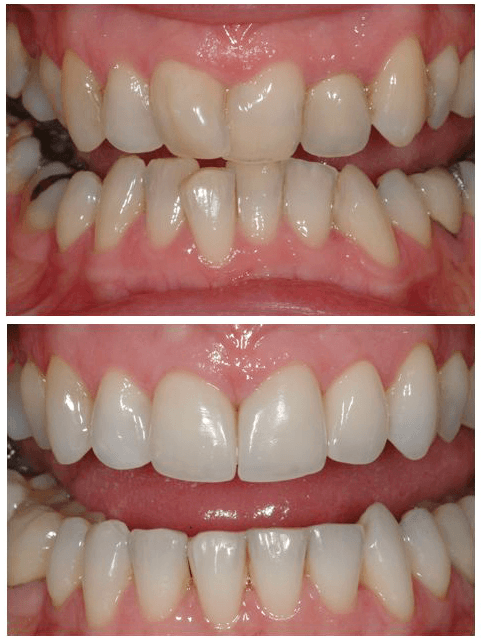
Here we have one of our dental patients who went for tooth coloured fillings, veneers, crowns, and dental implants. Orthodontic treatment was essential to re-align some of the teeth, create space for the implants, crowns and missing teeth. And the whole mouth restored with beautiful teeth coloured fillings, crowns and veneers. A happy end result, a much cleaner, brighter smile.
If you are thinking of getting braces to correct a dental problem, discover more on our dental blog stories: how to correct deep bite with braces.
Call us to learn more about our Orthodontic treatments, for child or adult braces, and other treatments, it could be life-changing for you too.